



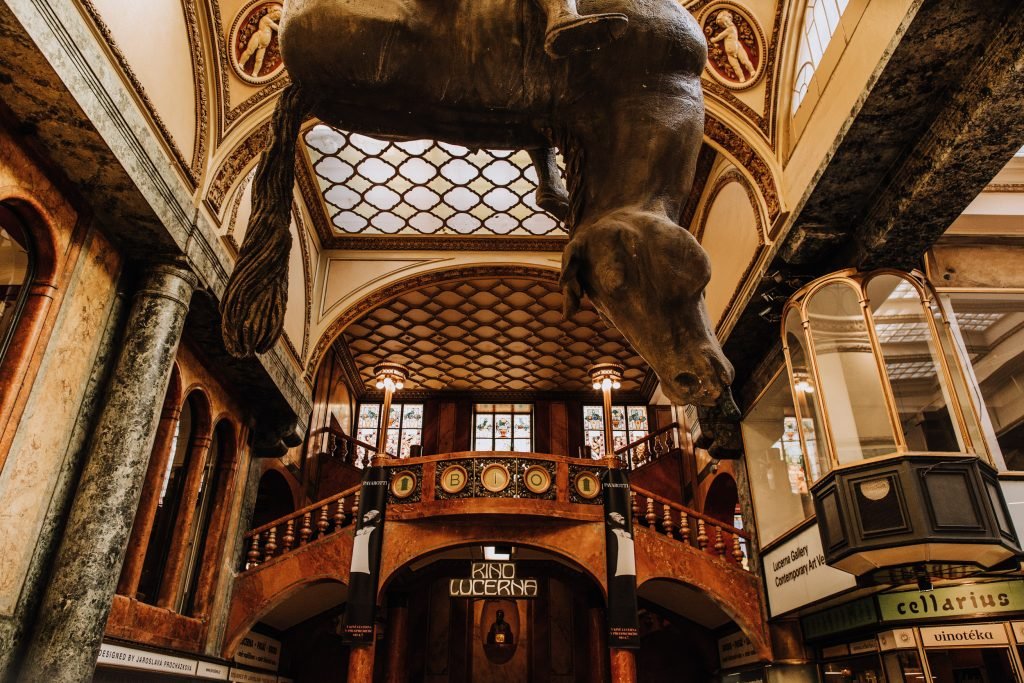
A few steps from Wenceslas Square, inside the Lucerna arcade in Prague’s New Town, a dead horse hangs by its legs from the ceiling with a king sitting calmly on its belly. This is one of the best-known works of the Czech sculptor David Černý, and one of the strangest sights in the city centre.
The Story of the Statue
The sculpture, usually just called Kůň (Horse), shows St. Wenceslas riding an upside-down horse. The horse’s legs are tied together like those of a captured animal, its head and tongue hang down, and the saint sits upright on its stomach as if nothing were wrong. Černý created the lightweight statue in 1999 for an exhibition in the courtyard of the Main Post Office in Jindřišská street. In 2000 it was moved to the Lucerna passage, where it has stayed ever since.
The work is an obvious parody of the famous equestrian statue of St. Wenceslas by Josef Václav Myslbek, which stands at the top of Wenceslas Square only a couple of minutes away. Černý has never given one official explanation, and it is usually read as an ironic comment on Czech politics and national myths. See the original first and then come here; the joke works much better that way.
Lucerna Palace
The setting is worth a visit on its own. Lucerna is an early twentieth-century complex of passages, a cinema, a café and a large music hall, built by Vácslav Havel, the grandfather of the later president Václav Havel. The horse hangs in the central atrium under a glass dome, in front of the marble staircase that leads up to the cinema and its café.
How to Find It
The passage runs between Vodičkova and Štěpánská streets, with entrances from both, and is free to walk through during the day and evening. The nearest metro stations are Můstek and Muzeum, and the Václavské náměstí tram stop is around the corner.
Photos


Photographing the Upside-Down Horse
This is an indoor subject, so the time of day matters less than usual. The atrium is fairly dark and the dome and windows behind the statue are bright, which makes exposure tricky: expose for the statue and let the glass burn out a little, or come on an overcast day or in the evening when the contrast is lower. A wide-angle lens is useful from directly below, where the horse’s head hangs towards you. For a calmer composition, go up the staircase towards the cinema and shoot from the landing, almost level with the rider. Raise your ISO rather than trying to set up a tripod in a busy passage. People walking underneath give a sense of scale, and mornings are the quietest time.
Planning more stops in the city? Browse more Prague guides for other places worth visiting and photographing.