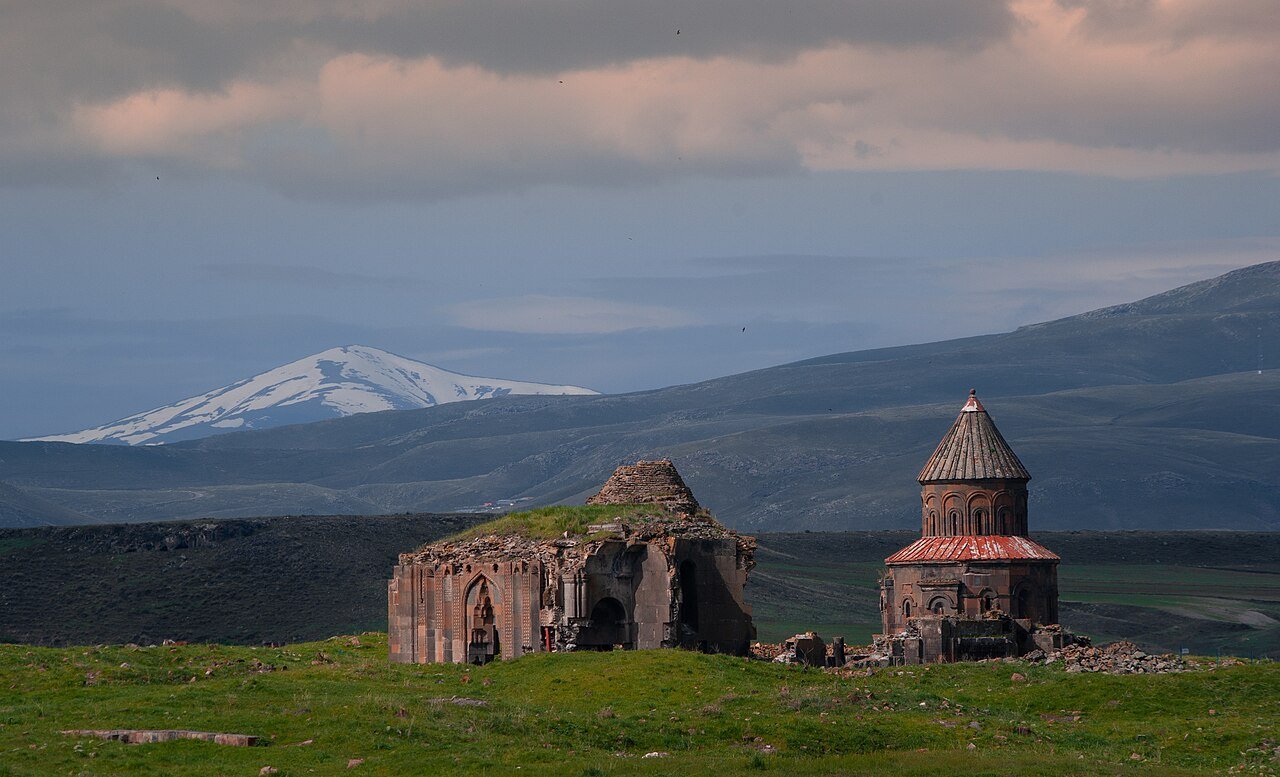
Ani is a ruined medieval city on a windswept plateau east of Kars, at the edge of a gorge that forms the border between Türkiye and Armenia. Once a capital of the Armenian Bagratid kingdom and a stop on Silk Road trade routes, it is now a wide field of grass with churches, a mosque and city walls standing far apart from one another. It was inscribed on the UNESCO World Heritage List in 2016. Few places in the country offer such scale and silence in a single frame.
What you will see
The site is large and the monuments are spread out. Allow at least two to three hours simply to walk it.
- The city walls and the Lion Gate. The double line of walls in reddish and dark volcanic stone is the first thing visitors meet, and it makes a strong opening backdrop.
- The Cathedral. A massive, roofless-domed building that dominates the centre of the site.
- The Church of St Gregory of Tigran Honents. Set on a slope above the gorge, with surviving frescoes inside and carved stonework outside.
- The Church of the Redeemer. Half of the building collapsed long ago, leaving it standing like a cross-section.
- The Mosque of Manuchihr. Perched on the edge of the gorge, with a minaret and wide views down to the Arpaçay river.
Permission, borders and drones
Ani is a ticketed archaeological site. Visitors take personal photographs freely, but professional and commercial shoots at such sites in Türkiye generally require permission from the authorities, and a session with wedding dress, lighting or a crew is likely to be treated as professional. Arrange this in advance through a photographer who knows the procedure; do not assume it can be solved at the gate.
The river below the site is an international border. Stay on marked paths, obey any signs and instructions from staff, and do not approach restricted areas. Drone flights in Türkiye require registration and permission in any case, and a border zone beside a protected monument is about as sensitive as locations get. Do not plan on aerial footage unless explicit authorisation has been obtained.
Seasons on the plateau
Kars has one of the harshest climates in the country, and Ani is fully exposed.
Winter is long and bitterly cold, with snow covering the ruins for months. Dark stone against white ground is spectacular, and winter travel to Kars has become popular thanks to the Eastern Express train. But sessions must be short, batteries drain fast and hands go numb.
Late spring and early summer turn the plateau green and scatter it with wildflowers. This is the most comfortable and colourful time.
High summer dries the grass to gold. There is almost no shade anywhere on the site, the sun is strong at this altitude and the wind is constant. Autumn is brief, with clear air and cold mornings.
Low sun suits Ani best, raking across the walls and bringing out the colour of the stone. Check the site’s opening hours for the season, as they determine how close to sunrise or sunset you can actually work.
Who Ani suits
This is a location for couples who want something epic and are willing to walk for it, for travel portraits and for small, simple wedding or anniversary sessions. It is not a convenient place for large groups, small children or elaborate styling: there are no facilities among the ruins, distances are long and the ground is rough. Wear sturdy shoes, bring water and a windproof layer, and keep hair and veils secured.
Getting there
Ani is about 45 kilometres from Kars by road. There is little public transport, so most visitors go by taxi, tour or hire car.
Booking a photographer for Ani
- Choose someone who has photographed at Ani before and ask for complete galleries from the site, ideally in the season you are visiting.
- Ask directly who handles permission and how long it takes.
- Clarify travel costs from Kars, or from further away if the photographer is based in another city.
- Agree on the number of edited images, the delivery time and a written contract with deposit and cancellation terms.
- Discuss a fallback for severe weather, such as the stone streets and old Russian-era buildings of Kars itself.
Search our photographer directory for photographers who travel to eastern Anatolia; those based in Kars are invited to add a free listing. You can also read more Türkiye photography guides.
Cover photo: Ani Harabeleri 2.jpg by Engin Tavlı, CC BY-SA 4.0, via Wikimedia Commons.
Photographers in Türkiye
Planning a photoshoot in Türkiye?
Tell us your date and the kind of shoot. We will check which photographers we work with there are available and reply by email, usually within two working days. Free, with no obligation.
Request a photographer