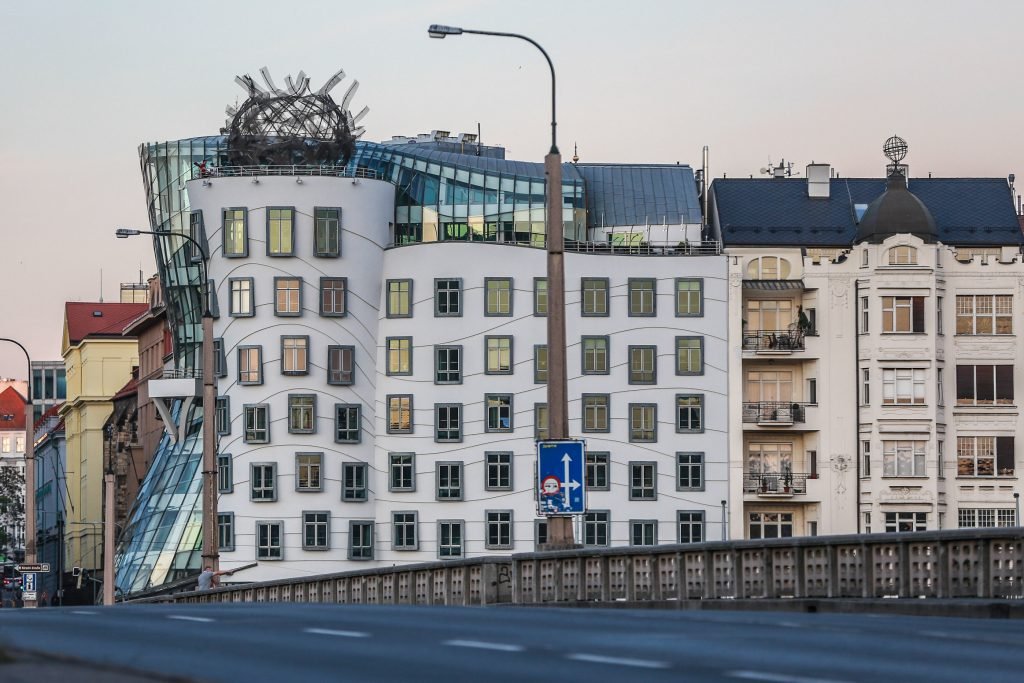
The Dancing House (Tančící dům) is the best-known modern building in Prague. Standing on the Rašín Embankment (Rašínovo nábřeží) beside the Vltava, among rows of 19th-century apartment houses, it looks as if two towers were caught in the middle of a dance step.
When was the Dancing House built?
Modern architecture “danced” onto the Rašín Embankment in 1996, after about four years of construction. The building fills a corner plot that had stood empty since the house there was destroyed in the bombing of Prague in 1945. Václav Havel, whose family owned the neighbouring house, supported the idea of a new cultural landmark on the site.

Who is the architect?
The project comes from the drawing board of two architects: Vlado Milunić, a Prague architect of Croatian origin, and the world-renowned Frank O. Gehry.


The concept was inspired by the famous film dance couple: the stone tower symbolises Fred Astaire and the glass tower his partner Ginger Rogers, which is why the building is nicknamed “Fred and Ginger”. The design was controversial at first, but it has long since become one of the symbols of the city.

What is inside and how to get there
The building houses a gallery, a hotel and a restaurant, and on the top floor a bar with a terrace offering a 360° view for anyone who wants to see Prague from above. Check the official Dancing House website for current opening times and conditions of entry.
The house stands at the corner of Jiráskovo náměstí, at the end of Jirásek Bridge. The tram stop is Jiráskovo náměstí, and Karlovo náměstí station on metro line B is a few minutes away on foot.


Photographing the Dancing House
- Best light. The main facade faces the river to the west, so it is in shade in the morning and lit by the sun in the afternoon. The best moment is the blue hour, when the windows glow and the trams leave light trails on a long exposure.
- Viewpoints. The classic angle is from the opposite corner of the junction, or from Jirásek Bridge with a slightly longer lens. From the far bank you can place the house in the row of embankment facades, and from the Petřín side, for example from Kinský Garden, it appears as a small detail in the wider city view.
- Portraits. The pavement by the river and the bridge railing work well for solo and couple portraits with the building behind. Use a wide aperture to soften the traffic.
- Crowds and traffic. It is a busy junction all day. Early morning, especially on a weekend, is the quietest time for clean pictures.


Looking for other places to visit and photograph? Browse more Prague guides on this site.
Proposing at the Dancing House
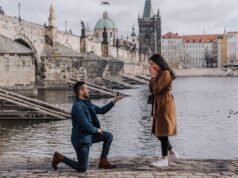
The Dancing House makes a fun, modern backdrop for a proposal, especially for couples who would rather skip the classic Old Town scenes. It stands on a busy junction, though, so the moment works best by the river rather than right at the corner.
- Is it a good place to propose? Yes, with some planning. Traffic and trams pass all day, so choose a spot on the riverside pavement or the bridge where you can stand still without blocking anyone.
- Best time: the blue hour, when the windows glow and the river is calm. If you prefer sunlight on the facade, come in the afternoon, as it is in shade in the morning.
- Permits and rules: a private proposal on the public pavement or bridge needs no permit. The rooftop bar and terrace are a private venue, so check their current rules, especially for props or a tripod. Drone flights in central Prague are restricted.
- Crowds: steady foot and road traffic all day. An early weekend morning is the quietest time.
- A quieter alternative: the railing of Jirásek Bridge, with the house behind you and the river below, feels far calmer than the junction.
- Where the photographer can wait: on the opposite corner of the junction or further along the bridge with a longer lens.
Comparing places? See our guide to the best places to propose in Prague.
Proposal & couple photography in Prague
Planning a proposal or photoshoot in Prague?
CandidYES photographs surprise proposals, engagements and couple sessions in Prague. Send your date and idea, and you will hear back within 24 hours with availability and a location suggestion.
Check availabilitySee Prague locations ›