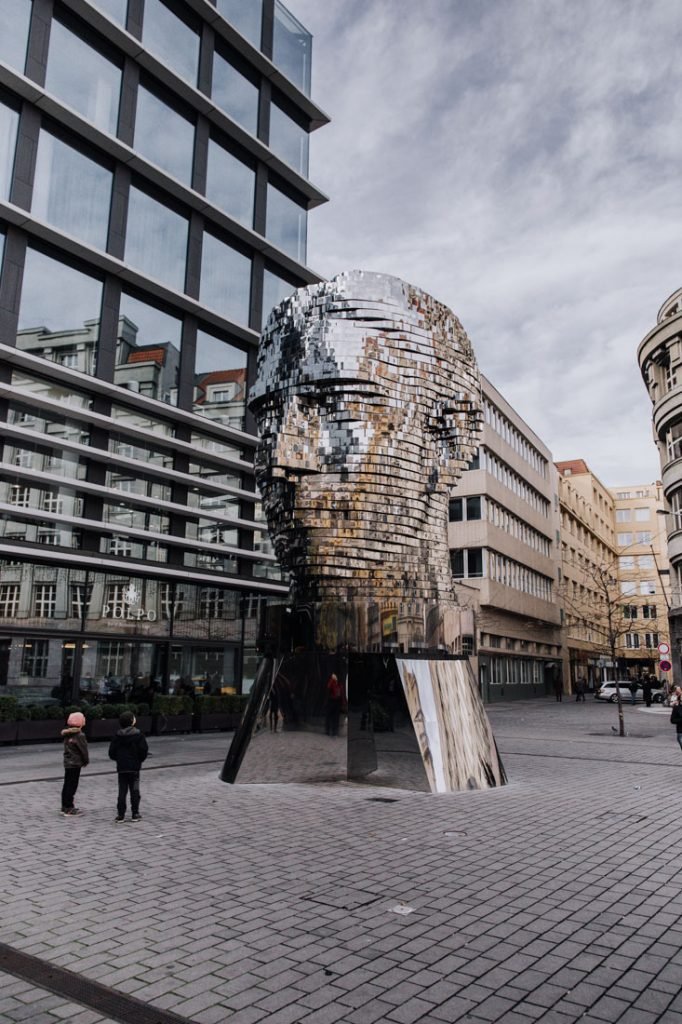
The Head of Franz Kafka is one of the most photographed pieces of modern art in Prague. It is an outdoor kinetic sculpture by the Czech artist David Černý, depicting the Prague-born, German-language writer Franz Kafka. The sculpture is about 11 metres tall and made of 42 mirrored stainless-steel layers. Each layer is motorised and rotates on its own, so the face slowly twists apart, dissolves into an abstract shape and then comes back together again.
About the sculpture
The head was installed in 2014 in the small square behind the Quadrio shopping centre in the New Town. David Černý is known for provocative public works across Prague, including the crawling babies on the Žižkov TV Tower and the hanging figure of Sigmund Freud in the Old Town. The constantly shifting face is usually read as a reference to Kafka’s tormented personality and to the theme of transformation that runs through his writing. The mirrored surface reflects the sky, the surrounding buildings and the people watching, so the piece never looks the same twice.
Where is Franz Kafka’s rotating head in Prague?
The sculpture stands outside the Quadrio centre, directly above Národní třída metro station on line B. Trams also stop at Národní třída. It is only a few minutes’ walk from the National Theatre, Wenceslas Square and the Old Town, so it is easy to add to any walk through the centre. There is no ticket and no fence; you can see it at any time.
The head does not rotate continuously. It moves in short programmed sequences, and it is occasionally stopped for maintenance. The schedule has changed over the years, so do not rely on old information: if seeing it in motion matters to you, check a current source before you go, or simply allow some time to wait.
Photographing the Kafka head
- Catch the movement. Shoot a series while the layers are turning. The most interesting frames are usually the half-scrambled ones, and the moment when the face lines up again.
- Try a slow shutter. With the camera held steady on a railing or a small tripod, a slower exposure blurs the moving layers while the buildings stay sharp.
- Best light. The steel is highly reflective. Overcast days give clean, even reflections; in sunshine you get strong highlights and blue sky in the mirrors. At dusk the lights of the square reflect in the panels and the sculpture looks its most dramatic.
- Angles. A wide-angle lens from close and low makes the head tower over you. Step back to include people for scale. The profile view is as good as the frontal one.
- Crowds. The square is small and fills with tour groups from late morning. Early morning or later in the evening is much quieter.
Looking for other places to visit and photograph? Browse more Prague guides on this site.
Proposing at Franz Kafka’s Rotating Head
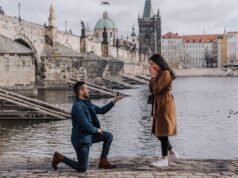
The Kafka head suits couples who love quirky modern art and want something different from the usual postcard views. It is a small, busy square, however, and the sculpture does not always move, so it is better for a playful moment than a quiet, private one.
- Is it a good place to propose? Yes, with caveats. The mirrored layers give unusual photos, but tour groups fill the square from late morning and the sculpture may be still or under maintenance when you arrive.
- Best time: early morning for fewer people, or dusk, when the lights of the square reflect in the steel panels.
- Permits and rules: no permit is needed for a private proposal in an open square. The square sits beside the Quadrio shopping centre, so for tripods, props or a professional shoot check the centre’s current rules first.
- Crowds: busy from late morning until evening. If seeing the head in motion matters, check a current source for its schedule and allow time to wait.
- A quieter alternative: the Franciscan Garden near Wenceslas Square, a few minutes’ walk away, offers benches, roses and a calm walled setting.
- Where the photographer can wait: a few steps back among the other visitors, framing the sculpture with you in profile.
Comparing places? See our guide to the best places to propose in Prague.
Proposal & couple photography in Prague
Planning a proposal or photoshoot in Prague?
CandidYES photographs surprise proposals, engagements and couple sessions in Prague. Send your date and idea, and you will hear back within 24 hours with availability and a location suggestion.
Check availabilitySee Prague locations ›